Connecting Iowa: A Statewide Linked Repeater Initiative
Iowa Radio Operators, in partnership with Statewide ARES, is working toward an ambitious goal: building a more connected amateur radio community across the state through a network of linked repeaters.
For years, amateur radio operators across Iowa have relied on local repeaters to stay connected with their communities. While these systems serve an important purpose, communications between different parts of the state can sometimes be limited by geography, repeater coverage, and the lack of connections between systems.
We believe there is an opportunity to change that.
Building a Connected Iowa
Our vision is to establish RF-linked repeater systems connecting Iowa's major population centers. Our priority is to build reliable over-the-air links wherever practical, creating a network that allows operators in different communities to communicate with one another without relying on internet connectivity.
We also recognize that RF linking isn't practical in every location. To help fill those gaps and extend the reach of the network, we intend to supplement RF connections with technologies such as AllStar and EchoLink.
By combining these approaches, we hope to create a flexible statewide network that supports everyday amateur radio activity while providing additional communications capabilities for public service and emergency response.
If it feels like we’ve been quiet this summer… trust me, we haven’t. Between Hamfests, contests, Field Days, camping trips, and the chaos of everyday life, the months flew by. Suddenly we blinked and landed in late October — but the work behind the scenes never stopped.
The IRO Discord continues to explode with growth, now passing 650 members and climbing. None of us could have imagined this many radio‑minded operators coming together to talk Ham, GMRS, Mesh, projects, troubleshooting, and everything in between. It’s become one of the strongest statewide resources for connection, collaboration, and community.
We kicked off the year with a productive DMRAA Hamfest, and Jason KD0MUB hit several more throughout the summer, handing out flyers, cards, and plenty of enthusiasm. Those efforts brought new faces into the community and helped expand our reach. We also joined the National Amateur Radio Alliance, a group of like‑minded operators working at a national scale. Their ideas, structure, and momentum give us a powerful blueprint to adapt for Iowa. If you haven’t checked them out yet, take a look at the great work they’re doing: https://usnara.org/.
This summer also saw the launch of Summer of Simplex and the 12 Days of Parkmas – Summer Edition. Both started small, but they planted the seeds for future statewide activities. A few 6m Moxon builds, plenty of FT8 contacts, and operators getting outside — exactly the kind of engagement we want to keep growing.
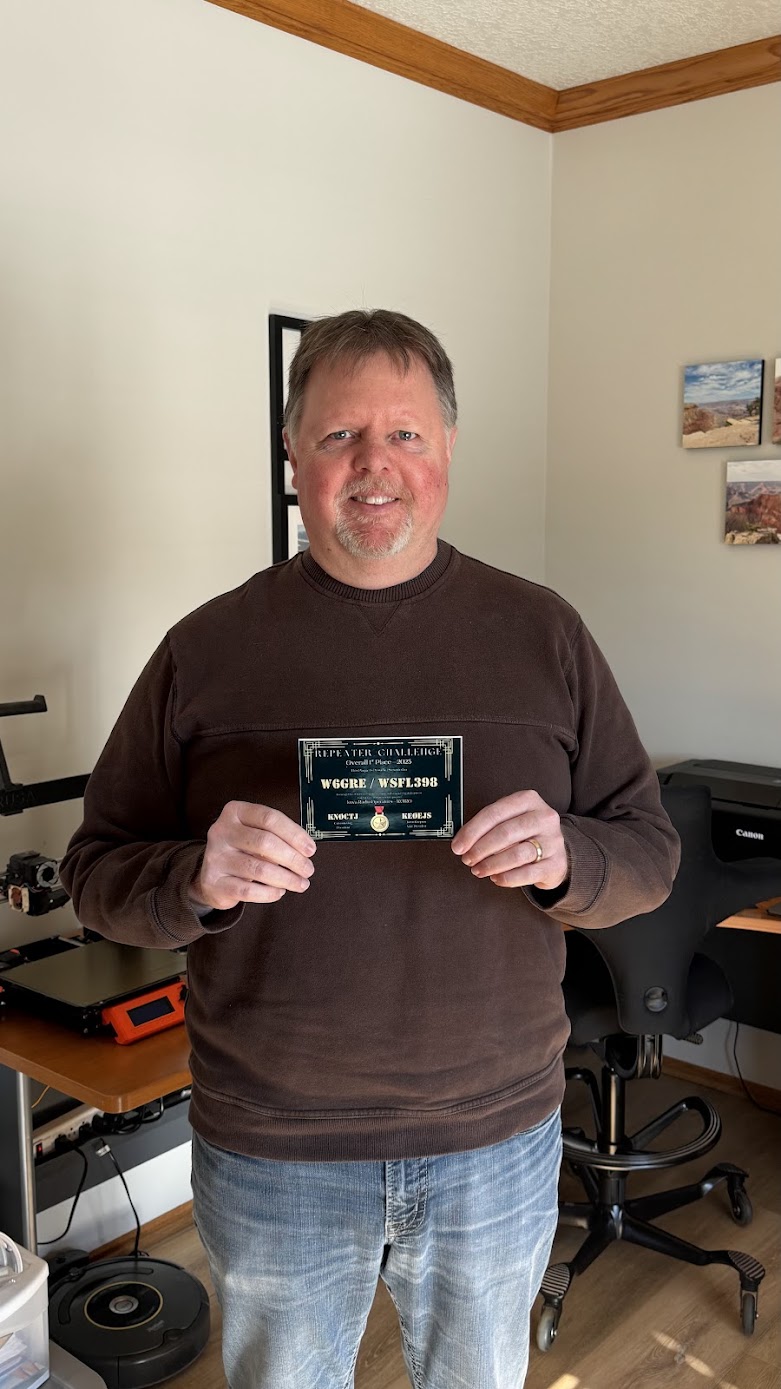
Congratulations to Jim - W6GRE / WSFL398!
Congratulations to Jim - W6GRE / WSFL398, who is the clear winner this month! Let's spread the word and get more folks involved. I'll have some flyers on my table on Saturday.
The momentum isn’t slowing down, and exciting developments continue in the world of amateur radio! Clint Miller, the newly appointed Iowa Section Emergency Coordinator, has shared an important update that’s worth highlighting.
After meeting and talking with Clint, it’s clear—he’s got vision, determination, and the drive to revitalize ARES and shape the future of emergency communications across the state. These topics have been a hot-button issue for a while, and now’s the perfect time to embrace positive change and push forward!
To keep discussions focused and productive, Clint has established a new Groups.io section for all ARES-related conversations:
Join the IA-ARES Discussion Group!
If emergency communications are your passion or you’ve been looking for a way to get involved, this is your chance! Head over to Groups.io, sign up, and stay engaged—big things are happening, and even bigger things are on the way!
Read more: Introducing Clint K0GR - Iowa Section Emergency Coordinator
Welcome to a fresh chapter in Iowa's amateur radio community! We're thrilled to introduce Barry WØIY, the new Iowa Section Manager, whose passion, vision, and leadership are set to inspire change and bring new energy to the world of ham radio.
In the letter that follows, Barry shares his thoughts on leadership, collaboration, and the challenges ahead. His words remind us all of the importance of teamwork and respect as we work together to enhance the amateur radio experience. Barry’s unique approach emphasizes the value of camaraderie, innovation, and collective action—principles that will undoubtedly resonate with hams across the state.
So grab a cup of coffee (or your favorite beverage), and take a moment to read Barry's message to the community. Together, let's support his vision for a stronger, more vibrant Iowa amateur radio community.
Read more: Introducing Barry WØIY: A New Era for Iowa Amateur Radio
This weekend I finally had the chance to catch up with Claus – AE0S, and it was great to hand over some well-deserved recognition.
Claus didn’t just participate in the 12 Days of Parkmas — he owned it. His consistency, his drive, and the sheer number of activations he pulled off made him the clear 1st place winner of this year’s event. Parkmas is no small lift, and Claus delivered from start to finish.
Seeing operators put that kind of energy into the hobby is exactly what keeps events like Parkmas fun, competitive, and worth running year after year.
For many repeater owners, AllStar can feel like something “other groups” use — big linked systems, complex controllers, or statewide networks. But the truth is much simpler: any repeater in Iowa can join the AllStar ecosystem with a small, stand-alone node and a single radio. No major rebuilds, no controller replacement, and no need to run a full-time computer.
A basic AllStar node can sit quietly at your site, connected to your repeater through a simple accessory cable or directly to a dedicated link radio. Add a small Yagi or directional antenna, and you’ve created a clean, reliable RF link into the AllStar network without touching your main repeater hardware.
What makes this especially appealing is how accessible the hardware has become. Solid, field-proven radios like the Motorola GM300 or Maxtrac make excellent link radios. Repeater-Builder and other vendors offer compact, purpose-built interface boards that handle audio, PTT, and COS cleanly. And the entire setup can be built to match your site’s needs — from a low-power link node to a rugged, rack-mountable solution.
K0IRO is excited to announce that ASL Hub1 is now live and available for use across Iowa. This is the first statewide AllStar hub built specifically to support communication, collaboration, and emergency readiness for repeater owners and operators throughout the state.
Hub1 is designed to be a shared meeting point — a place where local repeaters can link in, where operators can gather for statewide conversation, and where emergency services can rely on a stable, well-managed resource when coordination matters most.
In addition to serving as a central hub, Hub1 also operates as a voter, allowing multiple receivers across Iowa to feed into a single, clean audio path. This ensures wide coverage, clear audio, and a fair opportunity for everyone to be heard during nets, events, or emergency traffic.
Hub1 is available now as ASL Node 656839, and we’re excited to welcome repeater groups who want to participate.
If you’d like details on how to connect your AllStar node to the voter, or if you want help determining the best way to link your repeater, reach out anytime at
Sometimes the hardest part of being spread out across the state is actually getting prizes into the hands of the operators who earned them. But last weekend I finally had the chance to catch up with Jim – W6GRE and Scott – KE0ZBB, and it was great to hand out some well-deserved recognition.
A huge congratulations again to Jim, our overall champion of the Repeater Challenge. His consistency and drive put him solidly at the top.
And right alongside him, Scott – KE0ZBB deserves a big shout-out for taking 2nd place in the 12 Days of Parkmas. Scott put in the time and the effort — and it showed. Parkmas isn't a small lift, and he delivered.
Both of these guys put real energy into the hobby, and seeing their work pay off is exactly what keeps events like these fun and worth running.
More activity, more friendly competition, and more chances to celebrate the operators who keep Iowa talking.
If you’ve been around the hobby lately, you’ve probably noticed a trend: more and more operators are picking up QRP rigs. Some are brand-new to low-power operating, others are rediscovering the fun after years on the higher-wattage side of the dial. Either way, the spark is catching — and there’s no better example than the weekly QRP livestream hosted by Iowa’s own Kevin, K0KLB, and Steve, K04GSM.
Every Sunday, they fire up their tiny rigs and ask the question that defines the whole QRP spirit: “How low can you go?” It’s part challenge, part experiment, part celebration of what makes amateur radio such a unique and endlessly surprising hobby.
Why QRP Is Capturing So Much Attention
QRP isn’t about brute force. It’s not about being the loudest signal on the band or the biggest station on the block. It’s about finesse — understanding your antenna, reading the band conditions, and squeezing every bit of performance out of a handful of watts.
And that’s exactly why so many operators are falling in love with it.
- It’s accessible. A QRP rig can fit in a backpack, a glovebox, or the palm of your hand.
- It’s skill-building. You learn quickly what matters: timing, antennas, propagation, and patience.
- It’s portable fun. Parks, trails, backyards, picnic tables — QRP thrives anywhere.
- It’s budget-friendly. You don’t need a tower or a kilowatt to have a great time.
- It’s rewarding. When you make a contact on 5 watts, you feel it.
There’s something undeniably satisfying about hearing your call come back from hundreds or thousands of miles away when you’re running power levels that barely warm the finals.
Iowa Winlink Weekend is coordinated by the Muscatine Amateur Radio Club and is a great opportunity for amateur radio operators across the state to practice sending and receiving digital messages using Winlink in a realistic, public-service-focused setting.
Winlink is widely used for emergency and disaster communications, especially when internet or cellular service is unavailable. Events like this help operators:
- Build confidence with digital modes
- Test equipment and station setups
- Practice message handling and accuracy
- Stay ready to support served agencies when needed
Whether you’re an experienced Winlink user or just getting started, Iowa Winlink Weekend is a valuable chance to train, learn, and stay sharp.
The ARRL Iowa Section and K0IRO – Iowa Radio Operators are looking to connect with repeater groups, system trustees, hotspot owners, and individual operators across Iowa.
Are you currently using or supporting an AllStar node—whether it’s tied to a repeater, running on a hotspot, or operating as a standalone node?
Or maybe you’ve been considering adding one and want to learn how straightforward it can be.
If you’d like to share your setup, ask questions, or explore what AllStar could bring to your station or club, we’d love to hear from you.
You can reach us anytime at
We look forward to continuing the conversation and building stronger connections across Iowa’s amateur radio community.
Well here we are getting closer and closer to the end of 2025. I think we've had a momentous year with the work put out into the community. Lots of work and effort went into this summer by many parties, and I can't thank each and every one of you enough for it. I wish we would have gotten the picture this year, but I think we can come back for a picture in the spring and continue the work ahead!
I really want to wrap up and showcase the last bits of work through the summer and share that the K0IRO DMR repeater is now fully online and available for operators throughout the region.
When I first took over this site, there was only the 2m Repeater and DMR capabilities. At the time, the internet had been broken for some time and the DMR was not functional. Because we weren't sure of the future out there, we opted to pull the DMR off the 2m Repeater and figure out what was next.
Long story short, we ended up with AllStar on the 2m repeater, which left the desire to still re-establish DMR. As luck would have it (and twice luck, too), we were able to acquire another similar BridgeCom repeater. It was lightly used as an AllStar node for a guy, and he was happy to see it go to a good home.
Read more: K0IRO DMR Repeater & Digital Last Heard Dashboard
Introducing K0IRO-10 and K0IRO-15
As the dust of summer and fall finally settles, we have some exciting news about the work we've been putting in over the course of the past months. More to come—and eventually we’ll get a page just to document this stuff.
Let’s start out with the easier stuff to share!
K0IRO-10
The feedback I heard over and over was that APRS coverage was hit and miss on the eastern side of the state, and to some degree on the west. While working on the tower this summer, we had an opportunity to free up an antenna as we added others, so we wanted to take the opportunity to add some capabilities and coverage. That’s where K0IRO-10 spun up. It is currently hooked to a set of folded dipoles at 275 feet, giving good 360-degree coverage.
I feel like we’ve seen great coverage over the last couple of months across most of I-80. Today’s image doesn’t reflect that, but maybe that’s just a sign of the seasons. Either way, still excellent coverage and hopefully a help to quite a few out there.
We’re taking the airwaves to the next level—K0IRO has officially launched on Facebook and YouTube! That’s right, our Iowa Radio Operators club isn’t just connecting communities over RF anymore… we’re building bridges across timelines and newsfeeds too.
🔗 Follow us on Facebook for club updates, behind-the-scenes looks at our rigs and repeaters, and maybe even a few memes for good measure.
🎬 Subscribe on YouTube to catch timelapses, field day highlights, and tips from our talented operators.
Whether you're a seasoned ham or just curious what all those antennas are about, come join the conversation. This is just the beginning—and we’ve got a signal worth tuning into. 📻